Rust Cohort — Build a JSON Parser
Learn Rust by building something real
Move beyond syntax tutorials. In this 6-week cohort, you build your own JSON parser in Rust from scratch — covering enums, ownership, borrowing, error handling, FFI, and Python integration.
Price: €2,000 · Duration: 6 weeks · Format: Group cohort · Next start: April 20, 2026
A collaboration between belderbos.dev and Refactor Coaching.
Who is this for?
Developers comfortable with Python (or another language) who want to learn Rust through a real project. Not a "hello world" workshop — you'll build a parser that you benchmark against Python's json module.
Time commitment: ~10 hours per week.
Program overview
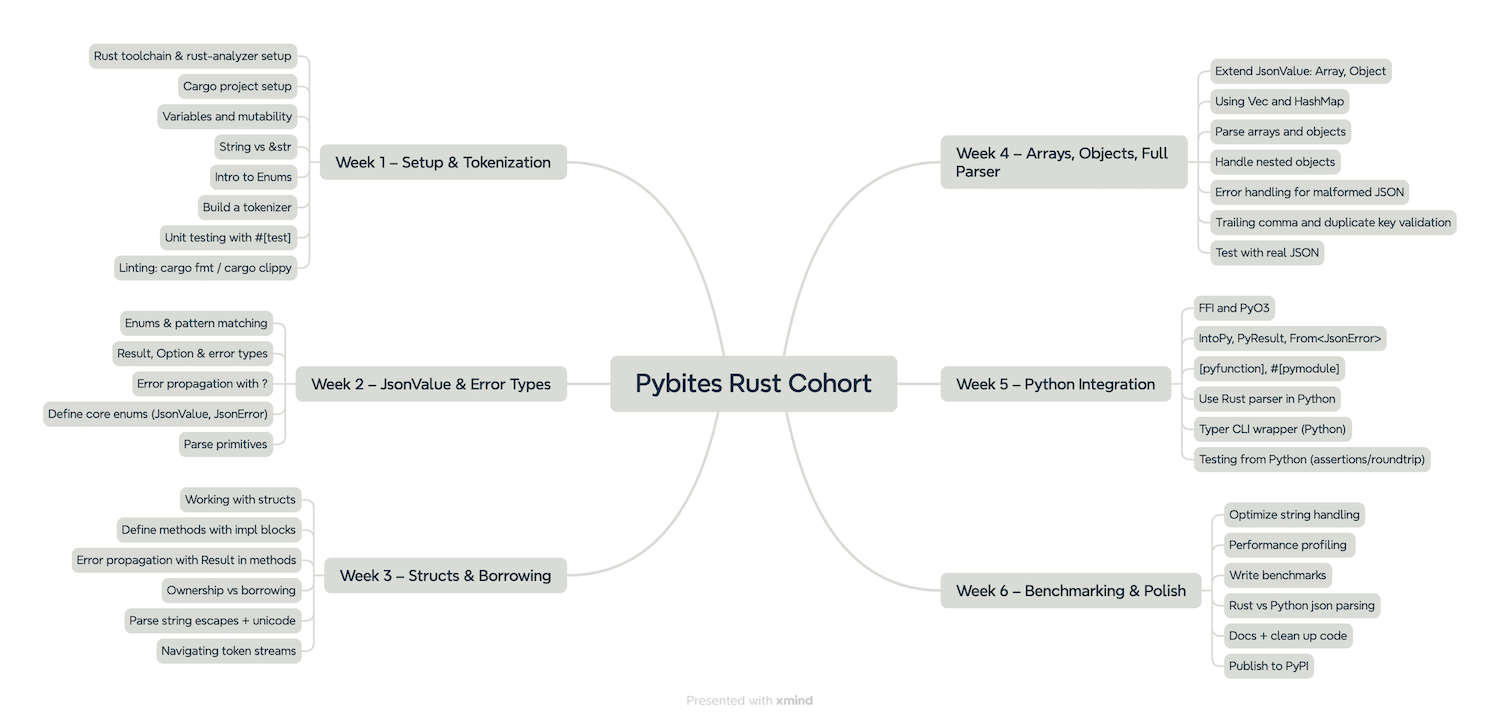
What you build, week by week
Setup & Tokenization
- Project setup with cargo
- Variables & mutability
- Basic types: String vs &str
- Testing with #[test]
- Build a JSON tokenizer
Types & Errors
- Enums & pattern matching
- Option<T> and Result<T, E>
- Error handling with ? operator
- Custom error types
- Parse primitive JSON types
Ownership & Borrowing
- Structs and impl blocks
- References: & and &mut
- Ownership vs borrowing
- Memory safety principles
- Structured parser with state
Collections & Recursion
- Vec<T> and HashMap
- Iterators and loops
- Recursive data structures
- Display trait for serialization
- Parse arrays & objects
Python Integration
- Foreign Function Interface (FFI)
- PyO3 Python bindings
- Cross-language memory management
- Build as Python extension
- Call Rust from Python
Polish & Optimize
- Performance measurement
- String allocation optimization
- Benchmark vs Python's json
- Documentation & examples
- Production-ready library
Tech stack: Rust (cargo, clippy, rustfmt), enums, ownership/borrowing, FFI, PyO3, #[test]
What's included
- Weekly group call with your coach
- Code review via GitHub PRs — detailed, honest feedback
- Professional, portfolio-ready project on GitHub
- Structured 6-week curriculum
- Access to invite-only community
Your coach

Jim Hodapp — Seasoned Rust developer, open source contributor, and software engineering coach with over two decades of experience. He's worked across the stack — from GNOME and Ubuntu to embedded systems and startups — and now mentors developers through Refactor Coaching to level up both technically and professionally. Whether you're new to Rust or ready to deepen your systems programming skills, Jim brings the perspective, structure, and guidance to help you grow.
What developers say
It's been a privilege being part of the Rust cohort — I genuinely enjoyed the work and the whole experience.
The hands-on approach made all the difference. Building something real made Rust click in a way that tutorials never could — and honestly, it's made me a better Python developer too.
I finished the parser last Thursday — my Rust implementation is only 0.8x slower than CPython's C and 10–12x faster than simplejson. Check it out: github.com/13hulk/rust-cohort
— Vikas Z.
Frequently asked questions
Do I need Rust experience? No. You need to be comfortable programming in another language (Python is ideal). We start from Rust basics and build up through the project.
What if I fall behind? Sessions are recorded for catch-up. You also have async support from Jim and the group throughout the week.
How much time per week? 6–8 hours including the live session, coding exercises, and building your parser.
Do we work solo or in teams? Solo work on your own parser, but you learn together. The group format creates accountability and peer support.
Will this help my portfolio? Yes — a JSON parser with FFI and Python bindings is a serious Rust project. Real commits, real tests, real benchmarks.
Want to learn Rust the right way? Book a free intake call → — or warm up with 60+ Rust exercises on rustplatform.com and read about Rust at rsbit.es.
Running a dev team? This cohort is a great way to upskill 5–10 developers together — get in touch for team pricing.